
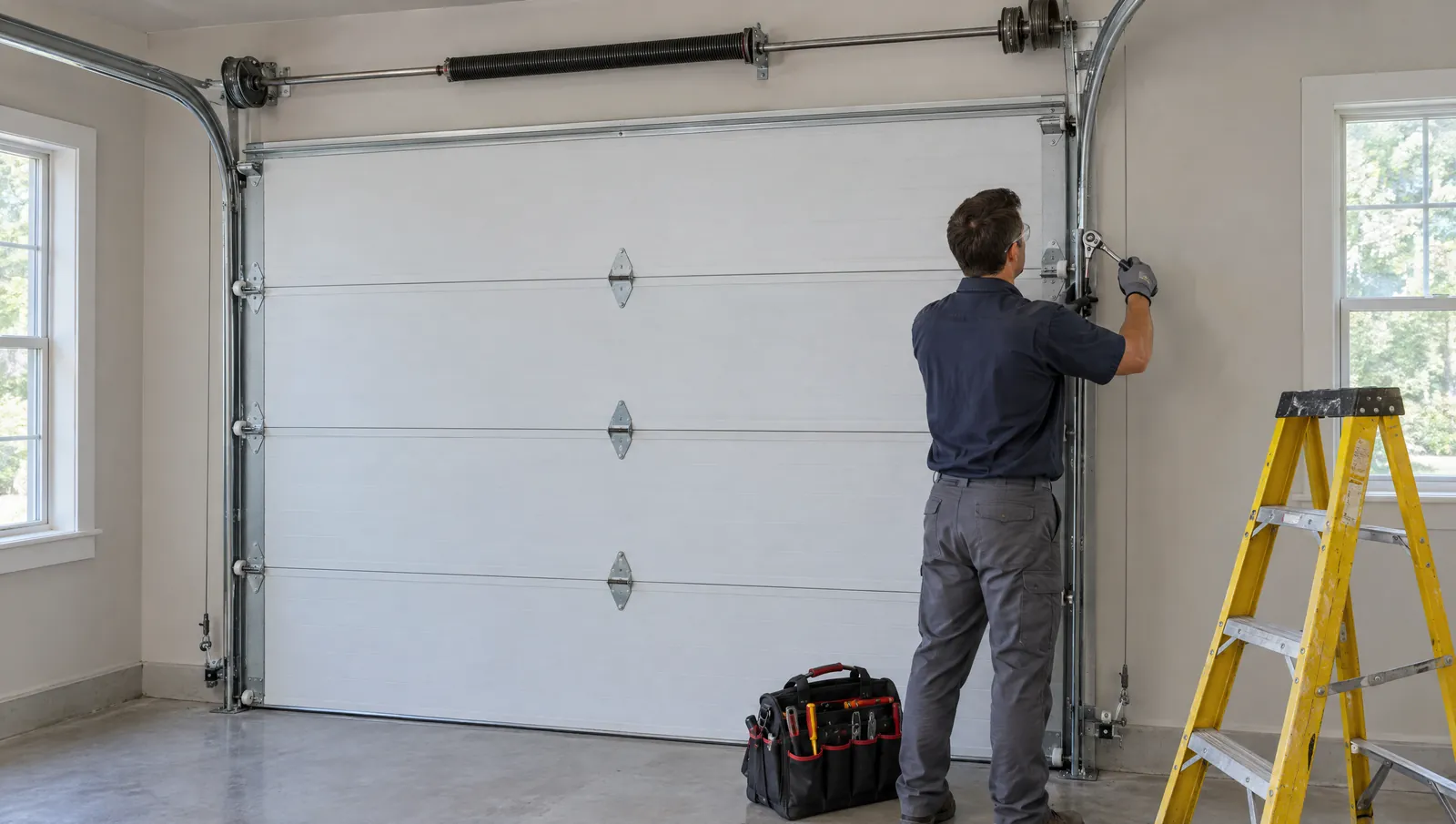
Broken Garage Door Spring in New Jersey?
Stop using the door and the opener. The springs carry the weight of the door. With one broken, the opener or anyone lifting by hand is moving the whole door, and it can drop. If the door is closed, leave it closed. Captain Garage Door Repairs & Installations replaces torsion and extension springs in Bergen, Passaic, Morris and Sussex counties. Call the New Jersey line at 973-803-0054.
Signs of a Broken Spring
- A bang like something heavy falling in the garage, often overnight or on a cold morning.
- A gap in the coil on the steel bar above the closed door.
- The door rises a few inches and stops, or the opener hums and gives up.
- The door feels extremely heavy by hand.
- Loose or hanging cables, or a door sitting crooked in the opening.
- The top of the door bends as the opener tries to pull it.
What to Do Right Now
| Your situation | Do this |
|---|---|
| Door is closed | Leave it closed and unplug the opener so nobody runs it by habit. |
| Door is closed and the car is inside | Say so when you call. Do not pull the red release and try to lift the door alone. |
| Door is stuck open or partly open | Keep everyone out from under it. Do not pull the red release: with no spring holding it, the door can fall. Lock the door from the garage into the house. |
| One of two springs broke and the door still moves | Stop anyway. The remaining spring and the opener are overloaded and the door is no longer balanced. |
Never loosen, unwind or remove a spring, and leave the cables, the drums at each end of the spring bar and the brackets at the bottom corners of the door alone. They hold the stored force.
Torsion or Extension: Which Do You Have?
| Torsion springs | Extension springs | |
|---|---|---|
| Where they are | On a bar across the wall above the door | Along each side, above the horizontal tracks |
| How they work | Twist to lift the door through cables and drums | Stretch as the door closes and pull through pulleys |
| Common on | Most doors fitted in recent decades; all heavier and double doors | Older and lighter single doors, and garages with little room above the door |
| When one breaks | A gap appears in the coil; the door will not lift | One spring hangs loose; the door lifts crooked |
| Worth knowing | Sized to the door's weight by wire size, diameter and length | Should have a safety cable running through the middle to contain a broken spring |
If your extension springs have no safety cable through them, ask to have cables added when the springs are replaced. It is a small addition that stops a broken spring from flying across the garage.
How We Replace a Spring
- Measure and match. The old spring is measured, or the door is weighed, so the replacement suits the door's actual weight and height.
- Replace the pair on a two-spring door, so both sides are equal.
- Inspect what the break may have damaged: cables, drums, the centre bearing, end bearings and the bottom brackets.
- Balance the door. Disconnected from the opener and lifted halfway, a correctly sprung door stays where it is left.
- Reconnect the opener and test its travel and safety reverse.
Ask about higher-cycle springs if the garage is the door your household uses most. They cost more at the outset and last through many more openings.
Why Springs Break in North Jersey Winters
A spring fails when it reaches the end of its cycle life, but the moment it lets go is often decided by the weather. Steel is more brittle in the cold, so worn springs tend to break on the first hard freezes. Road salt and damp garages add rust, which eats into the wire and adds friction between the coils. A light coat of garage door lubricant on the springs once or twice a year slows that down. It does not make an old spring new.
After a Spring Breaks, Check the Rest
A spring rarely fails alone. The jolt can fray a lift cable or throw it off the drum, and an opener that was run against the dead weight of the door may have a stripped gear. See garage door opener repair in New Jersey if the opener misbehaves once the door is balanced again, and garage door repair for everything else.
Spring Questions
Where We Replace Springs
Bergen County • Passaic County • Morris County • Sussex County