
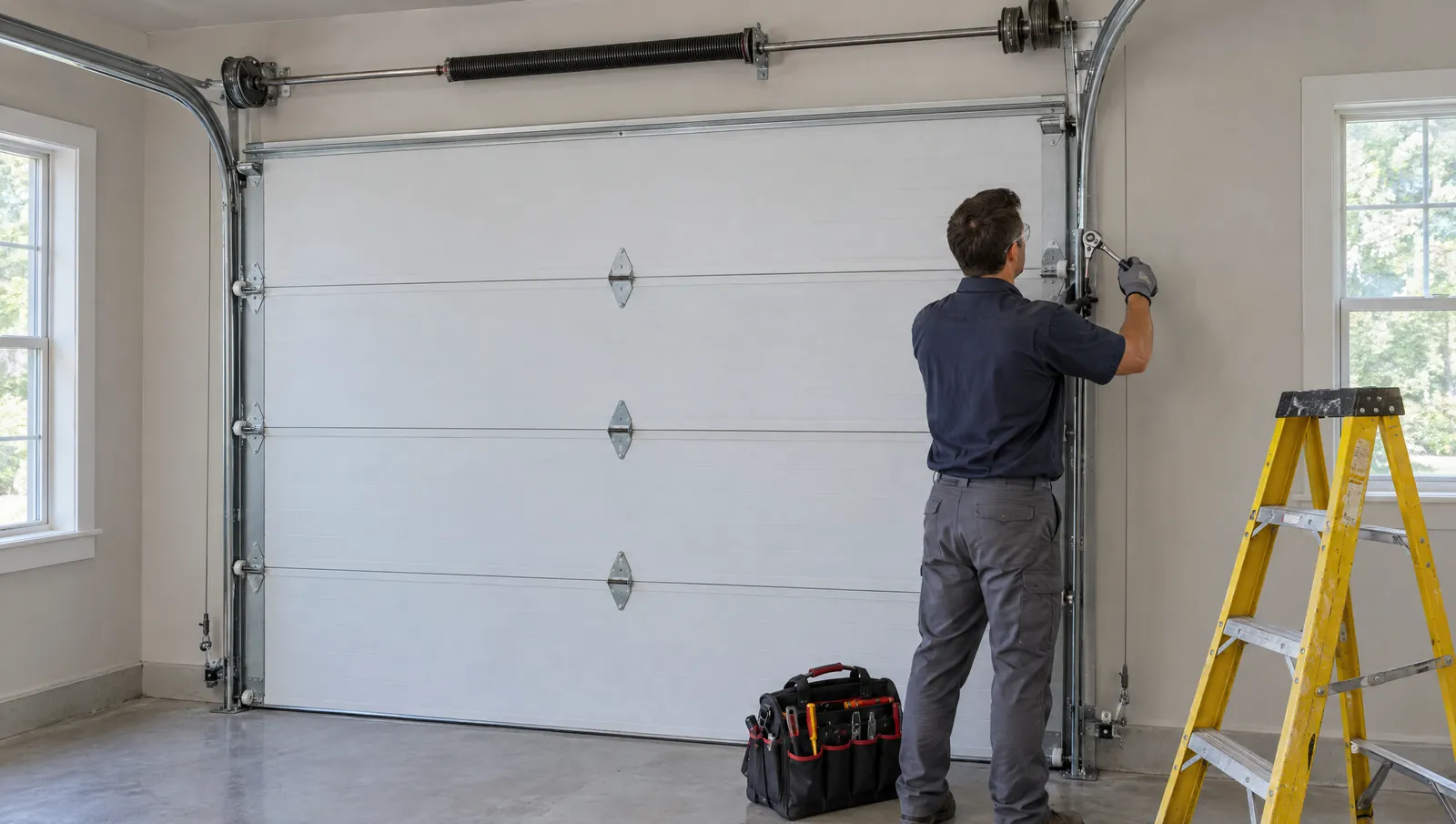
Garage Door Repair in Northern New Jersey
Most garage door failures come down to a handful of parts: the springs that carry the weight, the cables and drums that lift it evenly, the rollers and tracks that guide it, and the opener that starts and stops it. Captain Garage Door Repairs & Installations repairs all of them in Bergen, Passaic, Morris and Sussex counties. Call 973-803-0054 and tell us what the door is doing.
Problems We Repair
| What you notice | Likely cause | What the repair involves |
|---|---|---|
| Loud bang, door will not lift | Broken torsion or extension spring | Replace the spring (usually the pair), rebalance the door |
| Door hangs crooked or one side drops | Frayed or snapped lift cable, cable off the drum | Replace cables, reset drums, check the spring that caused the slack |
| Door jammed, rollers out of the track | Door off track after an impact or a broken cable | Secure the door, realign or replace track, replace damaged rollers |
| Grinding, squealing or shaking | Worn rollers, dry hinges, loose hardware | Replace rollers, tighten and lubricate, check balance |
| Opener hums or clicks, door stays put | Stripped drive gear, failed capacitor, broken spring | Diagnose the opener and the door together; repair or replace |
| Door closes then reverses | Safety sensors, travel limits, door binding | Realign or rewire sensors, reset limits and force |
| Dented or cracked section | Vehicle impact, storm damage | Replace the section where a match is available, or quote a new door |
Broken Spring Repair
The springs counterbalance the door, so a broken one leaves the opener, or anyone lifting by hand, moving the door's full weight. You will usually have heard a loud bang, and on a torsion spring you can see a gap of an inch or two in the coil above the door.
- What to do: stop using the opener and leave the door where it is. A closed door with a broken spring is stable.
- What not to do: do not pull the red release cord on an open door, and do not loosen or unwind a spring. Springs, cables, drums and bottom brackets hold stored force.
- The repair: the replacement spring is matched to the weight and height of your door. On a two-spring door both are normally replaced, because they have done the same work. The door is then balanced and the opener retested.
- Worth asking about: higher-cycle springs, if the garage is your main way in and out.
Full guide: garage door spring repair in New Jersey, including torsion and extension springs and what to do if a car is trapped.
Garage Door Opener Repair
An opener problem is often a door problem in disguise, so the two are checked together. Before you call, it helps to know what the opener does when you press the button.
- Hums or clicks but the door does not move: often a broken spring, a stripped drive gear or a failed start capacitor.
- Door closes and then goes back up: usually the safety sensors near the floor are blocked, dirty or out of line. Both small lights should be steady.
- Remote does nothing but the wall button works: the remote battery, or the wall control's lock feature is switched on.
- Nothing at all: check the outlet, the breaker and any GFCI outlet in the garage.
- Runs, but the door stays put: the red release may have been pulled, or the trolley or belt has failed.
An opener with no safety sensors, or with a failed circuit board that is no longer made, is usually better replaced than repaired. Belt-drive units are the quietest; wall-mounted units suit garages with little headroom.
Full guide: garage door opener repair in New Jersey, with a symptom table and the checks that are safe to try first.
Garage Door Cable Repair
Two lift cables carry the door's weight from the springs to its bottom corners. If one frays, snaps or slips off its drum, the door is lifted from one side only and twists in its tracks.
- Signs: a door hanging crooked, a slack or tangled cable, broken strands, or rust at the bottom few inches of the cable.
- What to do: stop using the door, unplug the opener and keep people and cars clear.
- The repair: both cables are replaced together, the drums, pulleys and bottom brackets are checked, and whatever caused the failure, often a spring or a binding track, is repaired too.
Full guide: garage door cable and off-track repair in New Jersey, including what to do with a door that is jammed or stuck at an angle.
Roller Replacement and Noisy Doors
A door that grinds, rattles or shakes on its way up usually has worn rollers. Each one carries part of the door's weight along the track, and once the bearings go, the door runs rough and the opener works harder.
- Signs: noise that follows the door up and down, a roller that wobbles on its stem or slides instead of turning, cracks or flat spots on the wheel.
- The repair: the full set is normally replaced, since they wear together. Nylon rollers with sealed bearings are much quieter than steel, which matters when a bedroom is over the garage. Hinges and track fixings are checked as well.
- What not to touch: the bottom rollers sit in brackets that hold the lift cables under spring tension. They are changed with the tension made safe, not by unbolting the bracket.
- If the noise is not the rollers: a dry spring, a loose hinge or a slack opener chain sounds similar. The whole door is checked before anything is replaced.
Dented or Damaged Panels
A sectional door is made of separate horizontal sections, so a damaged one can often be replaced without replacing the door.
- After an impact: stop running the opener until the door has been looked at. A buckled section can pull rollers out of the track. See cable and off-track repair.
- Can it be matched? That depends on whether the manufacturer still makes the model. A photo of the label on the inside edge of the door answers it quickly. Expect a new section to look a little brighter than sun-faded neighbours until it weathers or the door is repainted.
- Creased sections have lost their stiffness and flex with every cycle. They are reinforced with a strut or replaced.
- A top section bowing where the opener pulls needs a reinforcement bracket and strut before it cracks.
- Rust along the bottom edge is common where road salt collects. The bottom section holds the cable brackets, so it is replaced rather than patched.
- Two or more damaged sections: compare the cost with a new door.
What to Tell Us When You Call
- Your town and county.
- What the door is doing: stuck open, stuck closed, crooked, noisy, or reversing.
- Whether a car is trapped inside.
- Anything you can see: a gap in the spring coil, a loose cable, a roller out of the track.
- The opener brand, and whether its light or motor responds at all.
A photo sent by text often helps identify the part before the visit.
Why Garage Doors Fail Here
Northern New Jersey is hard on garage doors in ways that show up in the repairs we see:
- Cold snaps. Spring steel is more brittle in the cold, and springs that are near the end of their life tend to let go on the first hard freeze of the season.
- Road salt. Salt carried in on tyres sits on the floor against the bottom section, the bottom brackets and the lower ends of the cables, which is where corrosion starts.
- Freeze and thaw. Meltwater freezes the bottom seal to the slab. Running the opener against a frozen seal strips gears and tears the seal.
- Humid summers. Wooden doors and jambs swell, and doors that ran freely in March bind in July.
- Older housing. Many homes still have original tracks, extension springs without safety cables, or openers that predate modern safety sensors.
Repair or Replace?
A sound door with one failed part is worth repairing. Replacement starts to make sense when several sections are damaged, when the door is a discontinued model with no matching panels, when rust has reached the bottom section and its fixtures, or when repair quotes keep arriving a few months apart. If you are weighing it up, see garage door installation in New Jersey.
Repair Questions
Where We Repair Garage Doors
Bergen County • Passaic County • Morris County • Sussex County